Type "Burlington real estate for sale" into Google and you might land on listings near Boston before you ever see a house on Lake Ontario. There are two Burlingtons. One is in Massachusetts. The other sits between Hamilton and Oakville, right on the shore of Lake Ontario, and it's the one we work in every day. If you searched that phrase and meant the Canadian city, here's a real look at what's for sale, what it costs, and where people are actually buying.
Two Burlingtons, One Very Different Market
Burlington, Massachusetts is a small town outside Boston. Burlington, Ontario is a city of over 190,000 people in Halton Region, part of the Greater Toronto and Hamilton Area. Different country, different currency, different rules for buying a home. Land transfer tax works differently here. Mortgage rates follow the Bank of Canada, not the U.S. Federal Reserve. And every resale price you'll see quoted for this Burlington comes from the Realtors' Association of Hamilton-Burlington (RAHB), not a U.S. multiple listing service.
If you're relocating from the States, the biggest surprise usually isn't the search results mix-up. It's the closing costs. Non-resident buyers face extra rules and, in some cases, additional taxes on Ontario purchases. Worth a real conversation before you fall in love with a listing photo.
What's Actually For Sale in Burlington, Ontario Right Now
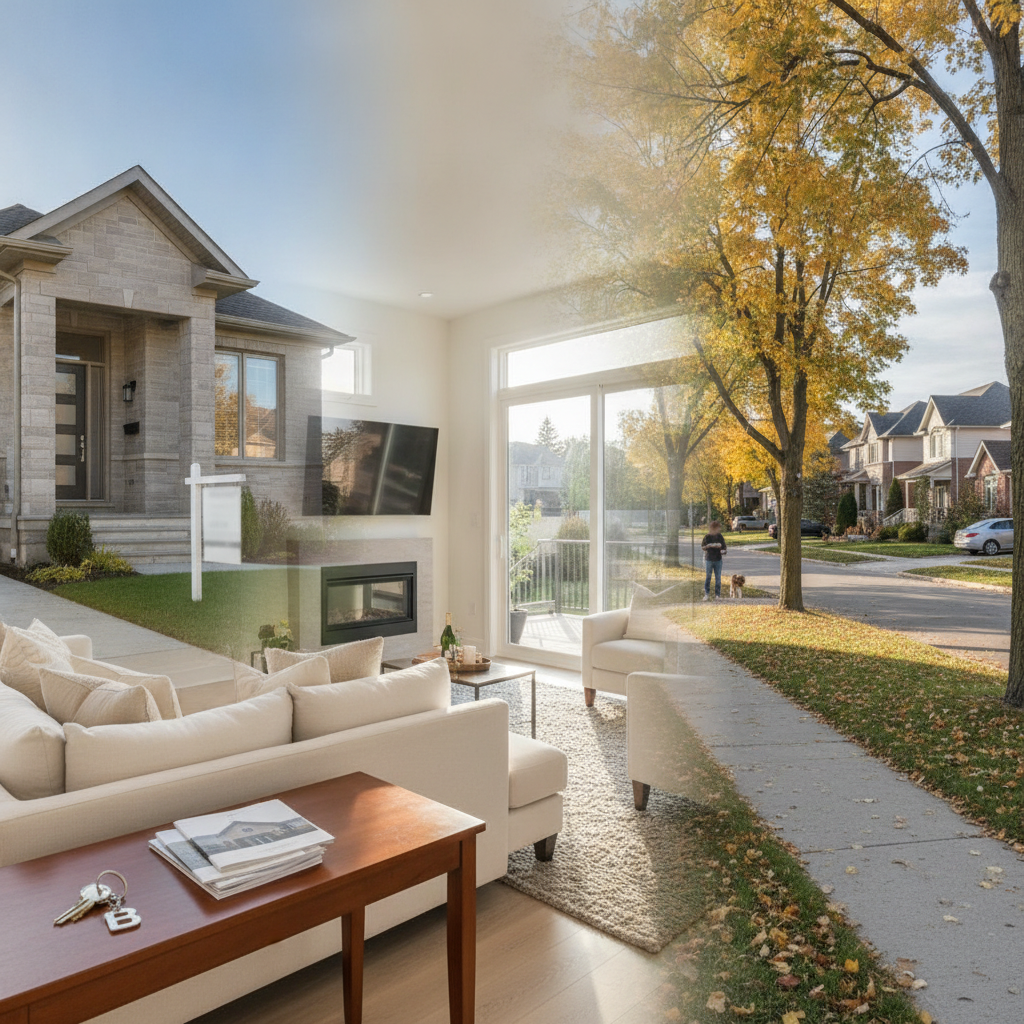
Burlington's resale market runs the full range. You'll find condos in the downtown core near Spencer Smith Park, detached family homes in Millcroft and Alton Village, and larger estate properties tucked into the Escarpment neighbourhoods like Mount Nemo and Kilbride. Waterfront and near-waterfront homes carry a real premium, and that segment behaves differently than the rest of the city, with fewer sales, longer negotiation periods, and buyers who are far more patient. We've written about what that upper end looks like right now in our look at selling above $1.5 million in this market, if that's the segment you're watching.
The fastest way to see what's genuinely active today, not a cached Google snippet, is to look at our current listings directly. Search engine results lag. A live feed doesn't.
The Neighbourhoods People Search For By Name
Most Burlington buyers don't just search "Burlington real estate for sale." They search a neighbourhood name once they know the area a bit. Here's the shorthand we hear most from buyers:
Aldershot, closest to Hamilton, tends to draw people who want a shorter commute and slightly older housing stock with room to renovate. Downtown Burlington, the strip near the lake and Brant Street, pulls in buyers who want walkability and are comfortable with condo fees. Millcroft and the north end are family territory, built mostly in the last 20 to 30 years, with good schools nearby. The Escarpment area, up near Mount Nemo, is where you'll find acreage, horse properties, and homes with real privacy, but also longer commutes and well water instead of municipal service.
If you're picking a Burlington neighbourhood from far away, that last detail matters. Well water, septic systems, and rural zoning rules aren't things every out-of-town buyer thinks to ask about until an inspection turns them up.
What Actually Moves Price Here
CREA and RAHB publish monthly benchmark price data for the Hamilton-Burlington market, and that's the only source we'd point you to for current numbers. What we can tell you without quoting a figure that'll be outdated by the time you read this: Burlington's price is shaped heavily by its GO Transit access, its school catchments, and its distance from the lake. A home ten minutes from the Burlington GO station will command more than a similar home twenty minutes out, almost every time. That's not a Burlington quirk. It's true across most GTA commuter cities, but it's especially visible here because the city is compact enough that the difference is a short drive, not a different postal code entirely.
Interest rate moves from the Bank of Canada also ripple through Burlington faster than through smaller markets, because so many buyers here are commuters stretching to afford proximity to Toronto. When rates move, offer activity on move-up homes shifts within weeks. We broke down the actual math behind that kind of move-up decision in this post on what buyers skip before giving up on moving up, and it applies whether you're buying your first Burlington home or your third.
Mistakes Out-of-Town and First-Time Searchers Make
The search mix-up between the two Burlingtons is common enough, but it's not the only confusion. A few patterns we see over and over:
Buyers assume Burlington, Ontario is part of Toronto proper. It isn't. It's its own city in Halton Region, with its own building department, its own development charges, and its own approval timelines. We wrote about how those timelines are actually changing in our piece on Burlington's building department speeding up permits, which matters a lot if you're buying with renovation plans.
Buyers also underestimate how much escarpment and rural properties differ from suburban ones. A listing that says "Burlington" might mean a 1,200 square foot bungalow five minutes from downtown, or a five-acre property with a well and no municipal sewer, forty minutes from the same downtown. Both are technically in the same city.
And buyers coming from cheaper markets sometimes assume Hamilton, right next door, is a cheaper backup plan without doing the math on commute time and lifestyle fit. Sometimes it is a smart move. Sometimes it isn't. It depends entirely on what you're trying to solve for.
If Waterfront or Luxury Is What You Actually Meant
If your search for Burlington real estate was really about the higher end of the market, lakefront estates, larger lots, custom builds, that's a distinct enough segment that it deserves its own look rather than a general search. Our page on Burlington luxury homes is built specifically for that search, with the kind of inventory that rarely shows up in a generic property portal search anyway, because a lot of it moves through private conversations before it's widely listed.
If your interest is actually a bit further out, toward wine country and the Niagara Peninsula, we cover that separately too through our Niagara properties page, since that market runs on its own rhythm entirely.
The takeaway: if you meant Burlington, Ontario, you're looking at a compact, commuter-driven city where price is set by GO Transit access, school zones, and how close you sit to the lake, not by a generic province-wide average.
Let's Talk About What You're Actually Looking For
A Google search can point you in the right direction, but it can't tell you whether a specific Burlington street fits your commute, your school needs, or your budget once land transfer tax and closing costs are in the picture. That part takes an actual conversation. Get in touch with our team and we'll walk through what's realistically available in your price range right now, and whether Burlington, Hamilton, or somewhere in Niagara actually fits what you're trying to solve for. You can also browse more of our thinking on this market on the Found Spaces blog while you're at it.